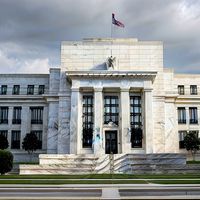
At a recent press conference, Federal Reserve Chairman Jerome Powell addressed economic issues. The ongoing economic vigor, coupled with inflationary measures anticipated from President-elect Donald Trump, suggests that the Federal Reserve might need to implement interest rate increases by 2025, cautioned a leading economist. Wall Street recently experienced a significant reaction to hints that the Federal Reserve will likely deliver fewer rate reductions than anticipated in the coming year. However, this economist has also warned of the possibility of a rate hike.
Apollo Global Management's Chief Economist, Torsten Sløk, ventured to assess the likelihood of such an occurrence. "The robust economy, paired with the potential for reduced taxation, elevated tariffs, and limitations on immigration, has heightened the risk that the Fed will be compelled to raise rates in 2025," he stated in a recent report. "We estimate a 40% chance that the Federal Reserve will increase interest rates by 2025."
Indeed, the economy's strength is so pronounced that the Commerce Department recently revised the third-quarter growth estimate upward to 3.1%, surpassing the initial projection of 2.8% and matching the second quarter's growth rate—indicating a slight acceleration in GDP. Furthermore, forecasts for the current quarter show no indication of a deceleration. The Atlanta Fed's GDPNow forecast anticipates another 3.1% growth for the fourth quarter. Sløk observed that this latest projection significantly exceeds the Congressional Budget Office's long-term growth estimate of 2%.
President-elect Donald Trump's campaign promises of tax reductions, increased tariffs, and a crackdown on immigration are widely seen as contributing to inflationary pressures. With inflation persistently exceeding the Fed's 2% target, these policies could limit the central bankers' ability to further lower rates after a 100 basis point reduction this year, bringing them to the range of 4.25%-4.50%.
In their economic projections for the upcoming year, Federal Reserve officials seemed to consider these actions as they notably raised inflation forecasts without corresponding adjustments to economic growth and unemployment estimates. "For investors, the situation is beginning to resemble 2022—elevated inflation, rising interest rates, and declining stock prices," Sløk added. In 2022, the S&P 500 plummeted 19%, and the Nasdaq nosedived 33%, marking the worst year for the markets since 2008.
Other Wall Street figures are also anticipating a more aggressive stance from the Federal Reserve in the coming year. Market veteran Ed Yardeni stated in a recent note that the likelihood of only one or even no rate cuts next year has increased. This assessment comes as the so-called neutral rate—the level that neither accelerates nor decelerates growth—remains uncertain, with analysts evaluating whether the economy can now handle tighter monetary policy than in the past.
"We believe that economic growth will be much stronger than the Fed anticipates, and therefore, the neutral rate is higher than 3.0%, possibly closer to 4.5%–5.0%," the Yardeni Research note indicated. "If real GDP growth surpasses the Fed's expectations, as we expect, then the FOMC may be on hold for a while." This narrative was originally featured on Fortune.com
By Samuel Cooper/Dec 22, 2024

By James Moore/Dec 22, 2024
By George Bailey/Dec 22, 2024

By David Anderson/Dec 22, 2024

By Sophia Lewis/Dec 22, 2024

By Ryan Martin/Dec 22, 2024
By Benjamin Evans/Dec 22, 2024

By Jessica Lee/Dec 22, 2024

By Amanda Phillips/Dec 22, 2024

By Noah Bell/Dec 22, 2024

By Emma Thompson/Dec 21, 2024
By Joshua Howard/Dec 21, 2024

By Amanda Phillips/Dec 21, 2024

By Victoria Gonzalez/Dec 21, 2024

By Laura Wilson/Dec 21, 2024

By Jessica Lee/Dec 21, 2024
By William Miller/Dec 21, 2024
By Eric Ward/Dec 21, 2024

By William Miller/Dec 21, 2024

By Benjamin Evans/Dec 21, 2024